
Time series analysis (MSAP4-02)#
import matplotlib.pyplot as plt
import numpy as np
import pandas as pd
import star_privateer as sp
import plato_msap4_demonstrator_datasets.plato_sim_dataset as plato_sim_dataset
K2: Preprocessing#
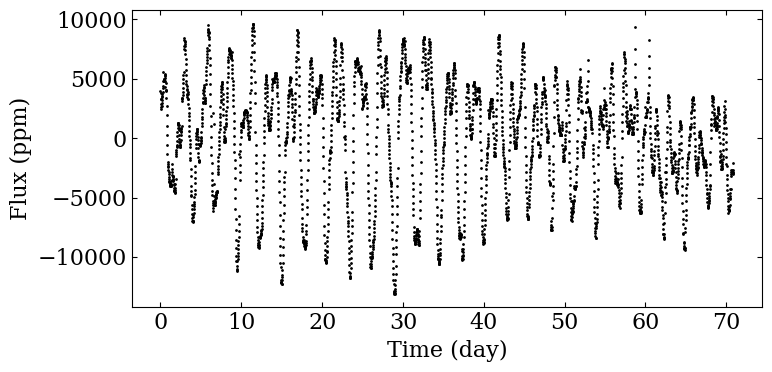
This first part include preprocessing tasks that are not actually included in MSAP4-02 but are useful for the subsequent analysis.
t, s0, dt = sp.load_k2_example ()
fig, ax = plt.subplots (1, 1, figsize=(8,4))

ax.scatter (t[s0!=0]-t[0], s0[s0!=0], color='black',
            marker='o', s=1)

ax.set_xlabel ('Time (day)')
ax.set_ylabel ('Flux (ppm)')

fig.tight_layout ()

plt.savefig ('figures/k2_lc.png', dpi=300)
pcutoff = 45
pthresh = 90
K2: Rotation period analysis#
In the next step, we compute the ACF and we analyse the characteristic periodicities obtained from the function, considering only periods below \(P_\mathrm{cutoff}\).
p_acf, acf = sp.compute_acf (s0, dt, normalise=True,
                                use_scipy_correlate=True, smooth=True, verbose=True)
_, _, _, _, prots, hacf, gacf = sp.find_period_acf (p_acf, acf, pcutoff=pcutoff)
fig = sp.plot_acf (p_acf, acf, prot=prots, filename='figures/acf_k2.png')
ACF was smoothed with a period 0.26 days
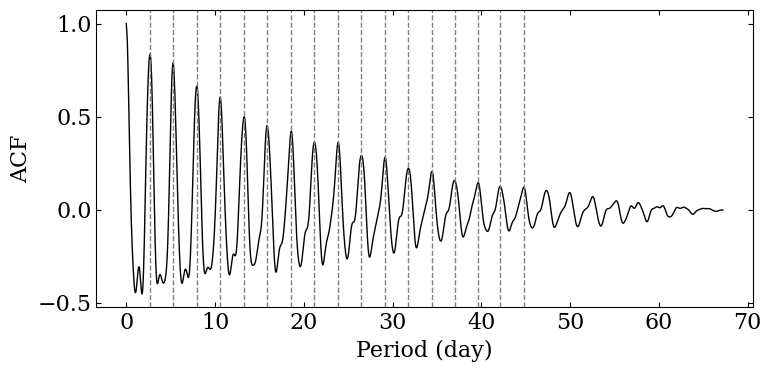
We can take a look at the values we have extracted from the ACF. Most
often, the rotation period can be linked to the first value of the
prots array.
prots[0], hacf[0], gacf[0]
(2.6765510971308686, 1.2594916191360066, 0.8353126108493093)
Finally we create the intermediate data product.
IDP_123_ACF_FILT_TIMESERIES = np.c_[p_acf, acf]
IDP_123_PROT_TIMESERIES = np.c_[prots, np.full (prots.size, -1), np.full (prots.size, -1),
                                hacf, gacf, np.arange (prots.size)+1]
np.savetxt ('data_products/IDP_123_PROT_TIMESERIES_K2.dat',
            IDP_123_PROT_TIMESERIES)
np.savetxt ('data_products/IDP_123_ACF_FILT_TIMESERIES_K2.dat',
            IDP_123_ACF_FILT_TIMESERIES)
df = pd.DataFrame (data=IDP_123_PROT_TIMESERIES)
df
| 0 | 1 | 2 | 3 | 4 | 5 | |
|---|---|---|---|---|---|---|
| 0 | 2.676551 | -1.0 | -1.0 | 1.259492 | 0.835313 | 1.0 |
| 1 | 5.271375 | -1.0 | -1.0 | 1.180853 | 0.786927 | 2.0 |
| 2 | 7.947927 | -1.0 | -1.0 | 1.017210 | 0.664006 | 3.0 |
| 3 | 10.583614 | -1.0 | -1.0 | 0.940327 | 0.605458 | 4.0 |
| 4 | 13.280597 | -1.0 | -1.0 | 0.771528 | 0.499477 | 5.0 |
| 5 | 15.875421 | -1.0 | -1.0 | 0.768302 | 0.452141 | 6.0 |
| 6 | 18.592836 | -1.0 | -1.0 | 0.741704 | 0.421836 | 7.0 |
| 7 | 21.187660 | -1.0 | -1.0 | 0.663556 | 0.363392 | 8.0 |
| 8 | 23.884643 | -1.0 | -1.0 | 0.641628 | 0.362309 | 9.0 |
| 9 | 26.499899 | -1.0 | -1.0 | 0.551047 | 0.292327 | 10.0 |
| 10 | 29.156018 | -1.0 | -1.0 | 0.524945 | 0.282007 | 11.0 |
| 11 | 31.791706 | -1.0 | -1.0 | 0.440642 | 0.222855 | 12.0 |
| 12 | 34.427394 | -1.0 | -1.0 | 0.392308 | 0.206277 | 13.0 |
| 13 | 36.981355 | -1.0 | -1.0 | 0.314554 | 0.157428 | 14.0 |
| 14 | 39.637474 | -1.0 | -1.0 | 0.276499 | 0.145753 | 15.0 |
| 15 | 42.109708 | -1.0 | -1.0 | 0.240641 | 0.126138 | 16.0 |
| 16 | 44.786260 | -1.0 | -1.0 | 0.226810 | 0.121512 | 17.0 |
df.to_latex (buf='data_products/idp_msap4_02_idp_prot_timeseries.tex',
             formatters=['{:.2f}'.format, '{:.0f}'.format, '{:.0f}'.format,
                         '{:.2f}'.format, '{:.2f}'.format, '{:.0f}'.format,],
             index=False, header=False)
Note that, due to the short length of this light curve, we do not show for this first case the analysis of long term modulations.
PLATO simulation: Preprocessing#
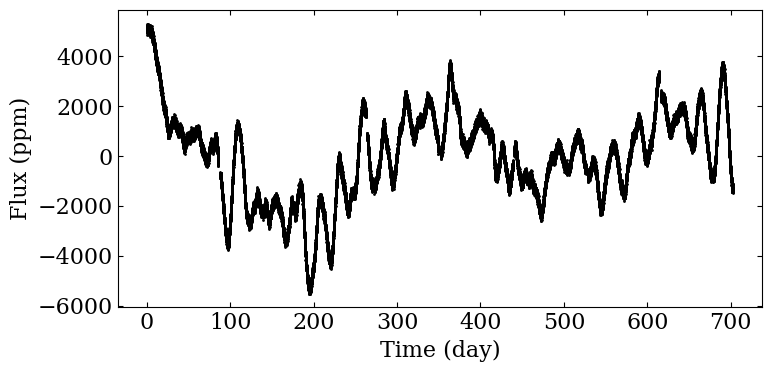
This first part include preprocessing tasks that are not actually included in MSAP4-02 but are useful for the subsequent analysis.
filename = sp.get_target_filename (plato_sim_dataset, '040', filetype='csv')
t, s0, dt = sp.load_resource (filename)
fig, ax = plt.subplots (1, 1, figsize=(8,4))

ax.scatter (t[s0!=0]-t[0], s0[s0!=0], color='black',
            marker='o', s=1)

ax.set_xlabel ('Time (day)')
ax.set_ylabel ('Flux (ppm)')

fig.tight_layout ()


plt.savefig ('figures/plato_lc.png', dpi=300)
s = sp.preprocess (t, s0, cut=55)
pcutoff = 45
pthresh = 90
PLATO simulation: Rotation period analysis#
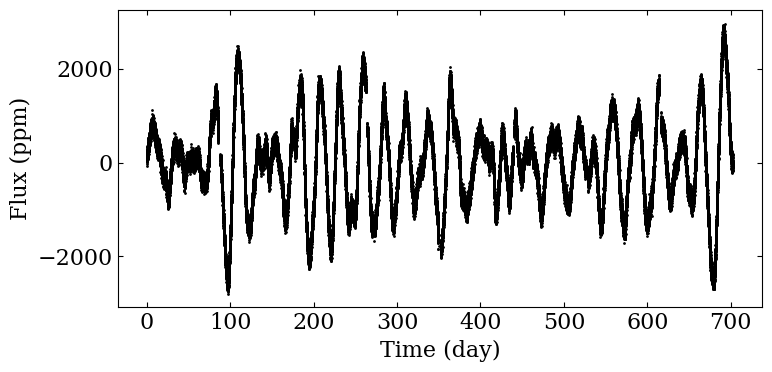
This first part include preprocessing task that are not actually included in MSAP4-02 but are useful for the subsequent analysis.
fig, ax = plt.subplots (1, 1, figsize=(8,4))

ax.scatter (t[s!=0]-t[0], s[s!=0], color='black',
            marker='o', s=1)

ax.set_xlabel ('Time (day)')
ax.set_ylabel ('Flux (ppm)')

fig.tight_layout ()

plt.savefig ('figures/plato_lc_filtered.png', dpi=300)
p_acf, acf = sp.compute_acf (s, dt, normalise=True,
                                use_scipy_correlate=True, smooth=True)
_, _, _, _, prots, hacf, gacf = sp.find_period_acf (p_acf, acf, pcutoff=pcutoff)
fig = sp.plot_acf (p_acf, acf, prot=prots, filename='figures/acf_plato_short.png')
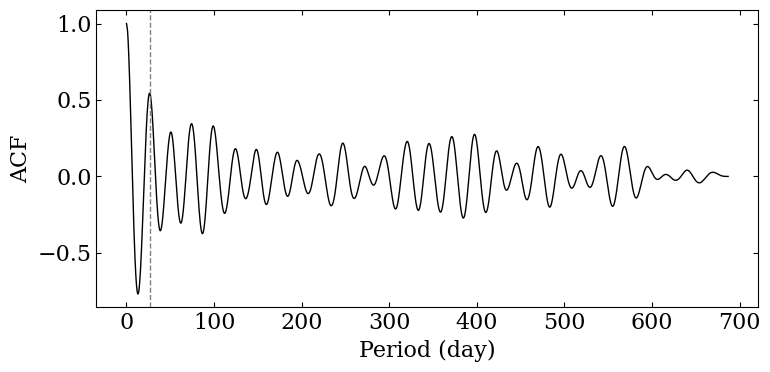
IDP_123_ACF_FILT_TIMESERIES = np.c_[p_acf, acf]
IDP_123_PROT_TIMESERIES = np.c_[prots, np.full (prots.size, -1), np.full (prots.size, -1),
                                hacf, gacf, np.arange (prots.size)+1]
np.savetxt ('data_products/IDP_123_PROT_TIMESERIES_PLATO.dat',
            IDP_123_PROT_TIMESERIES)
np.savetxt ('data_products/IDP_123_ACF_FILT_TIMESERIES_PLATO.dat',
            IDP_123_ACF_FILT_TIMESERIES)
PLATO simulation: Long term modulation analysis#
This time, we do not consider filtered out the data in order to consider long term modulations. We put a period threshold at 90 days to consider only long period in the postprocessing of our analysis.
p_acf, acf = sp.compute_acf (s0, dt, normalise=True, pthresh=pthresh, smooth_period=30,
                                use_scipy_correlate=True, smooth=True, verbose=True)
_, hacf, gacf, _, pmods, hacf, gacf = sp.find_period_acf (p_acf, acf, pthresh=pthresh)
fig = sp.plot_acf (p_acf, acf, prot=pmods, filename='figures/acf_plato_long.png')
ACF was smoothed with a period 30.00 days
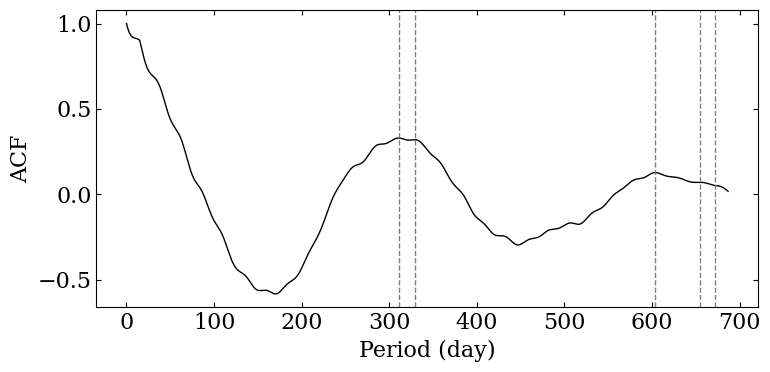
IDP_123_ACF_TIMESERIES = np.c_[p_acf, acf]
IDP_123_LONGTERM_MODULATION_TIMESERIES = np.c_[pmods, np.full (pmods.size, -1), np.full (pmods.size, -1),
                                                                hacf, gacf, np.arange (pmods.size)+1]
np.savetxt ('data_products/IDP_123_LONGTERM_MODULATION_TIMESERIES_PLATO.dat',
            IDP_123_PROT_TIMESERIES)
np.savetxt ('data_products/IDP_123_ACF_TIMESERIES_PLATO.dat',
            IDP_123_ACF_TIMESERIES)
df = pd.DataFrame (data=IDP_123_LONGTERM_MODULATION_TIMESERIES)
df
| 0 | 1 | 2 | 3 | 4 | 5 | |
|---|---|---|---|---|---|---|
| 0 | 310.678567 | -1.0 | -1.0 | 0.462692 | 0.329725 | 1.0 |
| 1 | 328.845118 | -1.0 | -1.0 | 0.282649 | 0.320247 | 2.0 |
| 2 | 603.628081 | -1.0 | -1.0 | 0.180539 | 0.127609 | 3.0 |
| 3 | 654.579144 | -1.0 | -1.0 | 0.010281 | 0.070637 | 4.0 |
| 4 | 671.849867 | -1.0 | -1.0 | -1.000000 | 0.050842 | 5.0 |
df.to_latex (buf='data_products/idp_msap4_02_idp_longterm_modulation_timeseries.tex',
             formatters=['{:.2f}'.format, '{:.0f}'.format, '{:.0f}'.format,
                         '{:.2f}'.format, '{:.2f}'.format, '{:.0f}'.format,],
             index=False, header=False)