
Fourier analysis (MSAP4-01A)#
import star_privateer as sp
import plato_msap4_demonstrator_datasets.plato_sim_dataset as plato_sim_dataset
import numpy as np
import matplotlib.pyplot as plt
import pandas as pd
K2: Rotation period analysis#
t, s, dt = sp.load_k2_example ()
fig, ax = plt.subplots (1, 1, figsize=(8,4))

ax.scatter (t[s!=0]-t[0], s[s!=0], color='black',
            marker='o', s=1)

ax.set_xlabel ('Time (day)')
ax.set_ylabel ('Flux (ppm)')

fig.tight_layout ()
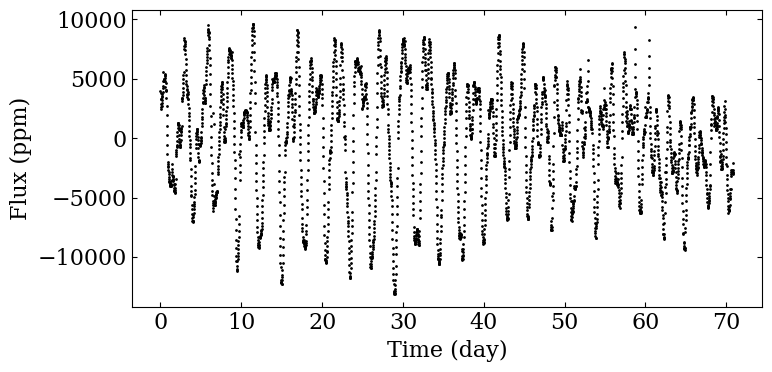
As we want to recover rotation periods below 45 days, we only consider the section of the periodogram verifying \(P < P_\mathrm{cutoff} = 45\) days.
pcutoff = 45
As a preprocessing step, we compute the Lomb-Scargle periodogram (in the SAS framework, it will be directyly provided by MSAP1).
p_ps, ps_object = sp.compute_lomb_scargle (t, s)
ls = ps_object.power_standard_norm
Now we perform the periodogram analysis.
cond = p_ps < pcutoff
prot, e_p, E_p, param, h_ps = sp.compute_prot_err_gaussian_fit_chi2_distribution (p_ps[cond], ls[cond], n_profile=20,
                                                                                     threshold=0.1, plot_procedure=False,
                                                                                     verbose=False)
sp.plot_ls (p_ps, ls, filename='figures/fourier_k2.png', param_profile=param,
               logscale=False, xlim=(0.1, 5))
IDP_123_PROT_FOURIER = sp.prepare_idp_fourier (param, h_ps, ls.size,
                                                  pcutoff=pcutoff, pthresh=None,
                                                  fapcutoff=1e-6)

df = pd.DataFrame (data=IDP_123_PROT_FOURIER)
df
| 0 | 1 | 2 | 3 | 4 | |
|---|---|---|---|---|---|
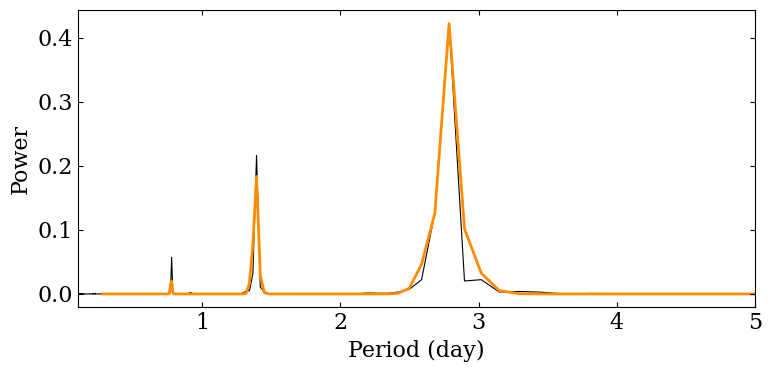
| 0 | 2.759429 | 0.036004 | 0.036968 | 0.422299 | 1.000000e-16 |
| 1 | 1.393418 | 0.013796 | 0.014075 | 0.216592 | 1.000000e-16 |
| 2 | 0.775871 | 0.007650 | 0.007804 | 0.057243 | 1.000000e-16 |
df.to_latex (buf='data_products/idp_123_prot_fourier_k2_211015853.tex',
             formatters=['{:.2f}'.format, '{:.2f}'.format, '{:.2f}'.format,
                         '{:.2f}'.format, '{:.0e}'.format],
             index=False, header=False)
np.savetxt ('data_products/IDP_123_PROT_FOURIER_K2.dat',
             IDP_123_PROT_FOURIER)
This time, we are interested in recovering long term modulations. We consider the section of the periodogram verifying \(P > P_\mathrm{tresh} = 90\) days.
PLATO: Rotation period analysis#
filename = sp.get_target_filename (plato_sim_dataset, '040', filetype='csv')
t, s, dt = sp.load_resource (filename)
fig, ax = plt.subplots (1, 1, figsize=(8,4))

ax.scatter (t[s!=0]-t[0], s[s!=0], color='black',
            marker='o', s=1)

ax.set_xlabel ('Time (day)')
ax.set_ylabel ('Flux (ppm)')

fig.tight_layout ()
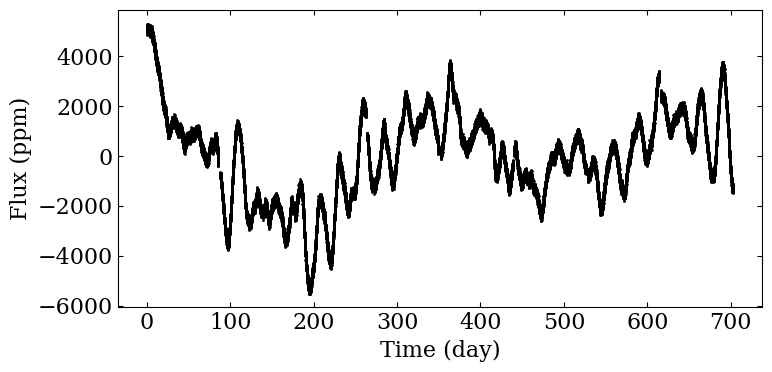
As we want to recover rotation periods below 45 days, we only consider the section of the periodogram verifying \(P < P_\mathrm{cutoff} = 45\) days.
pcutoff = 45
As a preprocessing step, we compute the Lomb-Scargle periodogram (in the SAS framework, it will be directyly provided by MSAP1).
p_ps, ps_object = sp.compute_lomb_scargle (t, s)
ls = ps_object.power_standard_norm
Now we perform the periodogram analysis.
cond = p_ps < pcutoff
prot, e_p, E_p, param, h_ps = sp.compute_prot_err_gaussian_fit_chi2_distribution (p_ps[cond], ls[cond], n_profile=20,
                                                                                     threshold=0.1,
                                                                                     verbose=False)
sp.plot_ls (p_ps, ls, filename='figures/fourier_plato_short.png', param_profile=param,
               logscale=False, xlim=(1, pcutoff), ylim=(-0.01, 0.1))
IDP_123_PROT_FOURIER = sp.prepare_idp_fourier (param, h_ps, ls.size,
                                                  pcutoff=pcutoff, pthresh=None,
                                                  fapcutoff=1e-6)
df = pd.DataFrame (data=IDP_123_PROT_FOURIER)
df
| 0 | 1 | 2 | 3 | 4 | |
|---|---|---|---|---|---|
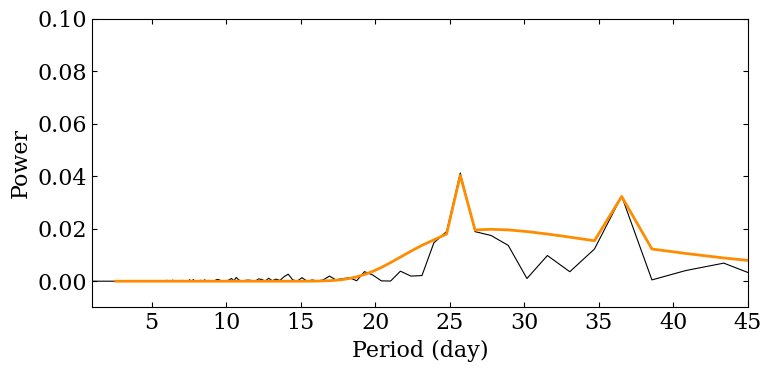
| 0 | 25.969122 | 5.252268 | 8.819944 | 0.041200 | 1.000000e-16 |
| 1 | 36.172726 | 9.338396 | 19.307071 | 0.032378 | 1.000000e-16 |
df.to_latex (buf='data_products/idp_123_prot_fourier_plato_040.tex',
             formatters=['{:.2f}'.format, '{:.2f}'.format, '{:.2f}'.format,
                         '{:.2f}'.format, '{:.0e}'.format],
             index=False, header=False)
np.savetxt ('data_products/IDP_123_PROT_FOURIER_PLATO.dat',
             IDP_123_PROT_FOURIER)
PLATO: Long term modulation analysis#
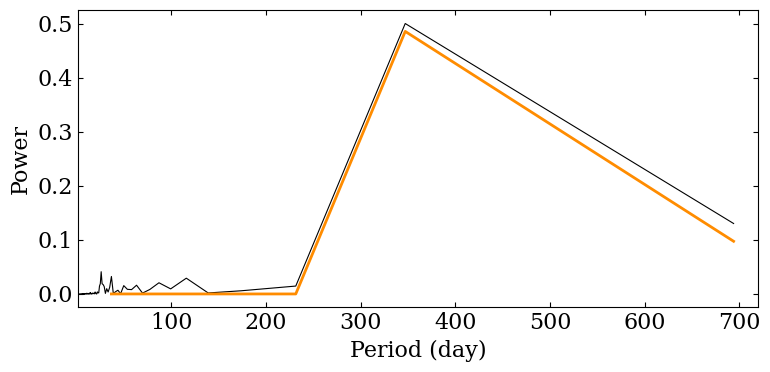
This time, we are interested in recovering long term modulations. We consider the section of the periodogram verifying \(P > P_\mathrm{tresh} = 90\) days.
pthresh = 90
As a preprocessing step, we compute the Lomb-Scargle periodogram (in the SAS framework, it will be directyly provided by MSAP1).
p_ps, ps_object = sp.compute_lomb_scargle (t, s)
ls = ps_object.power_standard_norm
Now we perform the periodogram analysis.
plongterm, e_p, E_p, param, h_ps = sp.compute_prot_err_gaussian_fit_chi2_distribution (p_ps[p_ps>pthresh], ls[p_ps>pthresh],
                                                                                          n_profile=5, threshold=0.1, verbose=False)
fig = sp.plot_ls (p_ps, ls, filename='figures/fourier_plato_long.png', param_profile=param,
                    logscale=False, xlim=(1,8*pthresh))
IDP_123_LONGTERM_MODULATION_FOURIER = sp.prepare_idp_fourier (param, h_ps, ls.size,
                                                                 pcutoff=None, pthresh=pthresh,
                                                                 fapcutoff=1e-6)
df = pd.DataFrame (data=IDP_123_LONGTERM_MODULATION_FOURIER)
df
| 0 | 1 | 2 | 3 | 4 | |
|---|---|---|---|---|---|
| 0 | 347.125305 | 31.560819 | 38.575413 | 0.500829 | 1.000000e-16 |
| 1 | 701.007116 | 64.295915 | 78.739851 | 0.130459 | 1.000000e-16 |
df.to_latex (buf='data_products/idp_123_longterm_modulation_fourier_plato_040.tex',
             formatters=['{:.2f}'.format, '{:.2f}'.format, '{:.2f}'.format,
                         '{:.2f}'.format, '{:.0e}'.format],
             index=False, header=False)
np.savetxt ('data_products/IDP_123_LONGTERM_MODULATION_FOURIER_PLATO.dat',
             IDP_123_LONGTERM_MODULATION_FOURIER)