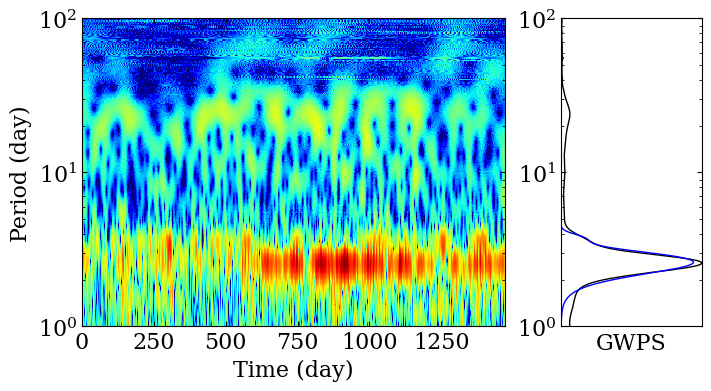
Wavelet analysis for rotation period extraction#
This notebook provide an example of analysis replacing the Lomb-Scargle periodogram by a wavelet analysis of the time series. The wavelet analysis is not a part of the PLATO MSAP4 rotation & activity baseline algorithms but it represents an interesting alternative in order to assess the performances of the framework.
import numpy as np
import star_privateer as sp
sp.__version__
'1.2.0'
A simple example#
Our working case is KIC 3733735.
filename = sp.get_target_filename (sp.timeseries, '003733735')
t, s, dt = sp.load_resource (filename)
In order to save computing time, we rebin the data in 4-hour bins.
dt *= 4
t = np.mean (t.reshape (-1,4), axis=1)
s = np.mean (s.reshape (-1,4), axis=1)
We now run the analysis pipeline. In particular, we can take a look at the plots made from the different analysis methods.
(p_wps, p_acf, gwps, wps, acf,
 cs, coi, features, feature_names, _) = sp.analysis_pipeline (t, s, figsize=(8,12),
                                                             wavelet_analysis=True, plot=True,
                                                             xlim=(0,50), normscale='log', ylogscale=True,
                                                             add_periodogram=True)
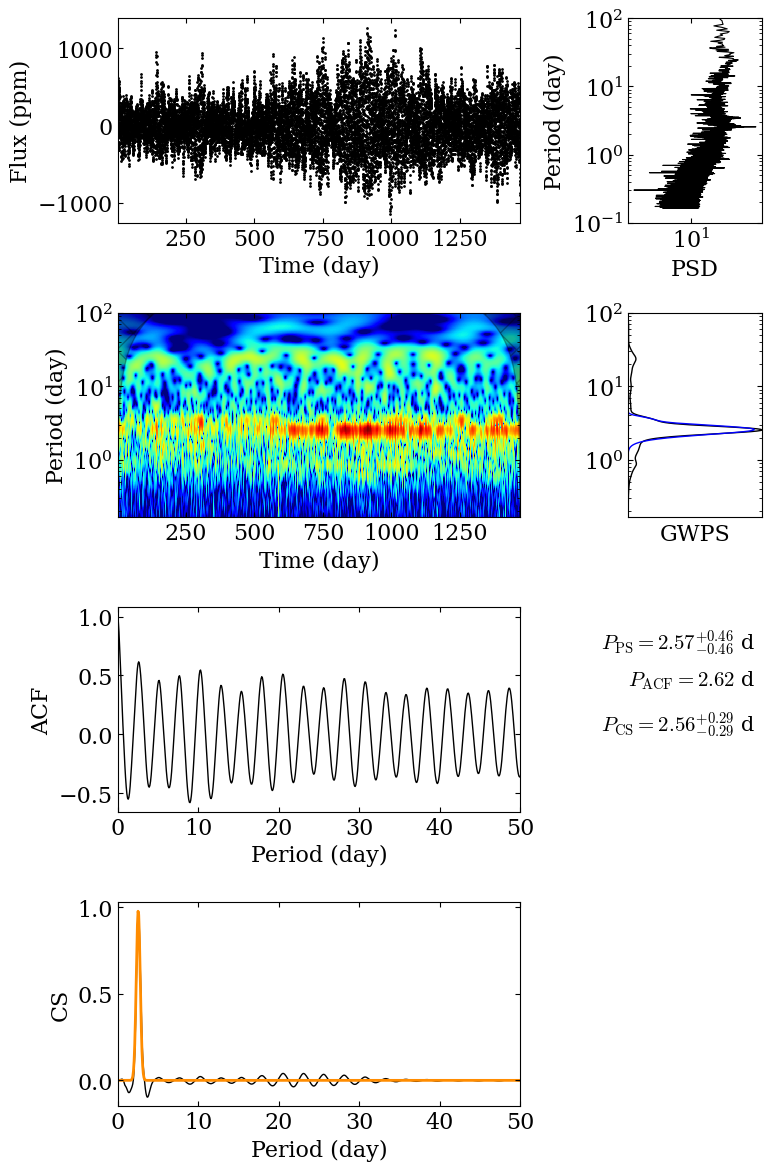
It is also possible to compute the wavelet power spectrum and plot it independently from the other methods.
dt = (t[1]-t[0])*86400
(periods, wps, gwps,
 coi, scales) = sp.compute_wps(s, dt, normalise=True, mother=None)
The GWPS peaks can be fitted with a set of Gaussian profile.
(prot_ps, E_prot_ps,
 param_gauss) = sp.compute_prot_err_gaussian_fit (periods, gwps, n_profile=5,
                                                       threshold=0.1)
fig = sp.plot_wps(t-t[0], periods, wps, gwps, coi=coi,
                     scales=scales, shading='auto', color_coi='darkgrey',
                     ylogscale=True, lw=1, normscale='log',
                     vmin=None, vmax=None, filename=None, dpi=300,
                     figsize=(8,4), ylim=(1, 100), show_contour=False,
                     param_gauss=param_gauss)
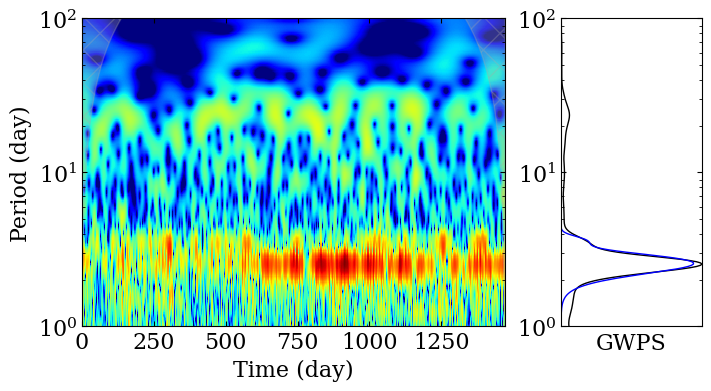
Note that from star_privateer=1.1.4, it is possible to use
pywavelets as backend instead of pycwt. In this case the cone of
influence will not be computed as it is not implemented yet in the
module.
dt = (t[1]-t[0])*86400
(periods, wps, gwps,
 _, scales) = sp.compute_wps(s, dt, normalise=True, mother=None,
                               backend="pywavelets")
(prot_ps, E_prot_ps,
 param_gauss) = sp.compute_prot_err_gaussian_fit (periods, gwps, n_profile=5,
                                                  threshold=0.1)
fig = sp.plot_wps(t-t[0], periods, wps, gwps,
                  scales=scales, shading='auto', color_coi='darkgrey',
                  ylogscale=True, lw=1, normscale='log',
                  vmin=None, vmax=None, filename=None, dpi=300,
                  figsize=(8,4), ylim=(1, 100), show_contour=False,
                  param_gauss=param_gauss)